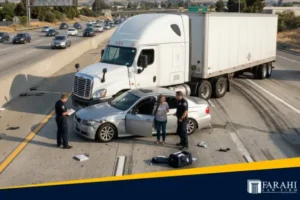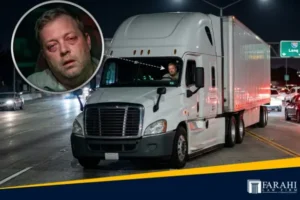

You’re driving home late on a California highway near Los Angeles when a commercial 18-wheeler truck suddenly drifts across lanes without braking. In seconds, flashing lights replace your evening plans. Witnesses mention the truck never slowed. No evasive movement. No braking. Just impact.
Later, you learn the truck driver had been on the road for hours.
That’s where hours-of-service rules come in. These federal safety limits, enforced by the Federal Motor Carrier Safety Administration (FMCSA) regulate driving time, rest breaks, and duty status. In this guide, you’ll learn what those rules require, how ELDs and driver logs can reveal fatigue, and how violations can significantly strengthen your injury claim.
What This Means for Accident Victims
When hours-of-service rules are violated, liability may shift from the individual driver to the motor carrier responsible for compliance.
This affects:
- Which federal hours-of-service regulations apply to your crash
- What evidence matters most (ELDs, driver logs, supporting documents)
- How quickly can that evidence disappear without legal action
- The overall strength and potential value of your injury claim
Federal Hours-of-Service Limits
The hours-of-service rules are federal safety limits enforced by the FMCSA under 49 CFR §395. These regulations restrict how long a property-carrying commercial motor vehicle driver may operate before mandatory rest.
In plain terms, the rules generally require:
- A maximum driving time limit within a workday
- Required rest breaks after consecutive driving hours
- Defined on-duty hours and off-duty time
- Specific sleeper berth rules for overnight rest
The Department of Transportation allows narrow exceptions, such as short-haul exceptions and limited extensions for adverse driving conditions. But these exceptions are tightly regulated—and often scrutinized after serious truck accidents involving driver fatigue.
Why Truck Driver Fatigue Increases Crash Risk
Truck driver fatigue slows reaction time, impairs judgment, and reduces awareness, especially during long stretches of on-duty time. On California highways, fatigue often appears as lane drift, delayed braking, speeding, or devastating rear-end collisions involving a commercial motor vehicle.
That is precisely why hours-of-service rules exist. When a motor carrier ignores federal driving limits designed to prevent exhaustion, the resulting crash is not random—it is a foreseeable safety failure under FMCSA standards.
Electronic Logging Devices and Records of Duty Status
To enforce hours-of-service rules, the FMCSA requires most interstate commercial motor vehicle drivers to use Electronic Logging Devices (ELDs). These systems automatically record a driver’s record of duty status, including driving time, on-duty not driving periods, and off-duty rest.
Unlike paper logbooks, electronic logs sync with the vehicle’s engine data, making it harder to conceal excessive duty hours. After a serious crash involving suspected truck driver fatigue, ELD records and supporting documents often become critical evidence.
ELD / Record | What It Can Show | Why It Matters in a Claim |
Engine hours/vehicle miles | Total operating time and distance driven | Verifies maximum driving time compliance |
Engine power up / engine shut down | When the truck was actively in use | Confirms actual on-duty time |
Driver’s record of duty status | On-duty not driving vs. off-duty periods | Detects rest break violations |
Driver logs & supporting documents | Fuel receipts, shipping records, DVIRs | Corroborates or challenges compliance claims |
Logbook Falsification and ELD Malfunctions
Not every violation of hours-of-service rules appears clearly on the surface. Some drivers or motor carriers may falsify logbook entries, misclassify on-duty time, or claim an ELD malfunction after a crash.
Red flags can include:
- Missing driver logs or incomplete Records of Duty Status
- A recorded data diagnostic event indicating system irregularities
- Discrepancies between electronic logs and supporting documents (fuel receipts, inspection reports, shipping records)
In serious truck accident claims, reviewing these records is essential. What looks like a technical error may become key proof of noncompliance under federal safety regulations.
Pressure From Trucking Companies and Fleet Managers
Violations of hours-of-service rules rarely occur in isolation. Motor carriers often operate under strict delivery windows tied to interstate commerce contracts, shipping document numbers, and performance metrics.
Operational pressure can include:
- Incentives to maximize duty hours
- Penalties for late deliveries
- Financial consequences tied to shippers
- Internal expectations to “keep driving.”
When fleet managers prioritize schedules over compliance, truck driver fatigue becomes a foreseeable risk. In injury claims, that pressure can support arguments of corporate negligence, not just individual driver error.
How Violations Strengthen Injury Claims in California
Violations of hours-of-service rules can significantly strengthen a truck accident claim—often extending liability beyond the driver to the motor carrier itself.
Under FMCSA standards and California personal injury principles, both the driver and the company must comply with federal safety regulations designed to prevent truck driver fatigue. When those rules are broken, it may support negligence and vicarious\ liability.
Building that case typically requires:
- Preserving driver logs and ELD records
- Securing driver vehicle inspection reports
- Requesting supporting documents
- Working with accident reconstruction experts
When records reveal noncompliance, they increase leverage in settlement negotiations and expand exposure for serious injury damages under California law.
How Los Angeles Truck Accident Lawyers Can Help
When violations of hours-of-service rules are suspected, fast action matters. The best truck accident lawyers in Los Angeles know how to secure and analyze critical compliance evidence before it disappears.
At Farahi Law Firm, we can help you to:
- Preserve ELD data output and request roadside electronic data transfer records
- Demand supporting documents from the motor carrier
- Coordinate accident reconstruction to prove truck driver fatigue
- Handle aggressive insurance pressure and protect your claim
In complex truck accident cases, strategic investigation often makes the difference between denial and recovery.