If you ever need to dispute police report car accident information, you’re not alone. Police officers do their best, but car crash scenes are chaotic, and mistakes happen. These mistakes can severely impact your insurance claim or legal case.
When an officer misidentifies the at-fault driver, overlooks injuries, or documents incorrect details, victims often face unfair blame or reduced compensation. If you live in San Pedro or drive busy roads like Gaffey Street and Pacific Avenue, accuracy matters more than ever.
Understanding how to correct these issues is the first step toward protecting your rights and ensuring that the truth is accurately reflected.
How Inaccurate Police Reports Lead to Denied or Undervalued Claims
Insurance companies rely heavily on police reports when determining fault and payout amounts. When the report is wrong, your claim may be denied or undervalued, especially in disputed liability cases. Even minor errors, such as misstated weather conditions, misinterpreted witness statements, or overlooked injuries, can unfairly shift blame.
Too often, crash victims assume that once the report is written, it cannot be changed. But a flawed report can and should be challenged. When you dispute police report car accident details early, you increase your chances of receiving the fair settlement you deserve.
Common Errors Officers Make When Documenting Crash Details
Police officers gather as much information as possible, but they are only human. They may arrive after the collision occurred and rely on secondhand accounts.
Common mistakes include:
- Incorrect vehicle positions or directions of travel
- Misstated driver statements or misunderstood descriptions
- Wrong time, date, or location
- Misspelled names or incorrect license plate numbers
- Missing injury descriptions
- Misinterpreting property damage
- Assigning fault without considering all the evidence
- Failing to include road conditions or traffic light sequences
These issues can significantly affect your claim. If the officer labels you as partially at fault or misreads skid marks, it can change how insurers view your case.
Steps to Formally Request Corrections to a Police Report
Correcting a police report is a formal process, but entirely possible. Here’s how to start:
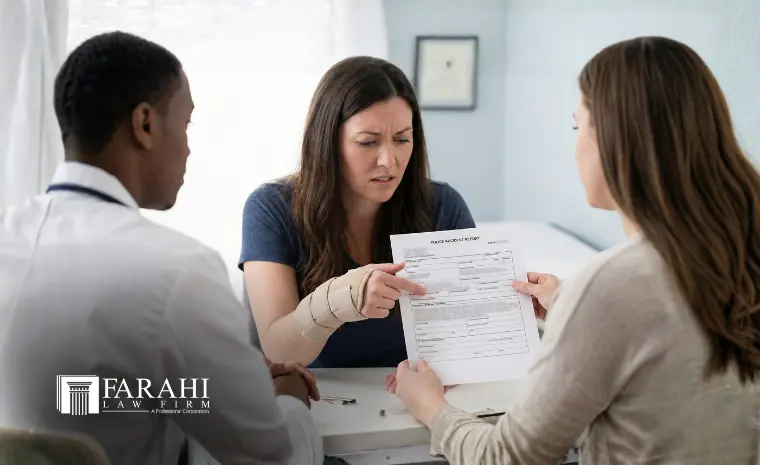
1. Request a Copy of the Report
This ensures you review every section and identify inaccuracies.
2. Highlight Errors Clearly
Point out factual mistakes—dates, times, witness statements, or location details.
3. Prepare Written Evidence
Gather photos, videos, dashcam footage, hospital reports, or witness statements.
Provide clear explanations of the corrected facts.
4. Submit a Supplemental Statement
California allows you to submit an official written statement to the responding police department.
5. Follow Up
Police departments are busy. Be persistent, polite, and documented in your communications.
When you dispute police report car accident details correctly, officers may update or attach your supplemental information permanently to the report.
How Supporting Evidence Can Override a Flawed Police Report
Even if a report isn’t corrected, strong evidence can outweigh it. Insurance adjusters and courts consider:
- Dashcam footage
- Surveillance videos from nearby businesses
- Accident reconstruction reports
- Medical documentation
- Photos of the scene
- 911 recordings
- Black box data
This evidence often holds more weight than an incomplete or inaccurate police report. If your injuries appeared hours later, such as whiplash, back pain, or concussions, medical documentation can override what the officer recorded on scene.
Supporting evidence is the most effective tool when disputing errors that harm your claim.
Read related article: How Evidence Can Make or Break Personal Injury Claims
When a Personal Injury Lawyer Is Essential for a Disputed Report
Sometimes, errors are minor. But there are instances in which a bad report can destroy your entire claim, primarily if the insurer uses it to deny responsibility. This is when hiring a top-rated personal injury lawyer in San Pedro becomes essential.
Our experienced injury lawyer can:
- Analyze the police report for errors
- Gather missing evidence
- Reconstruct the crash
- Contact witnesses on your behalf
- Communicate with officers to request updates
- Challenge insurance companies attempting to underpay
- Strengthen your case in disputed liability situations
You don’t have to navigate the dispute process alone. With the right lawyer, you significantly improve your chances of getting a corrected report and a fair settlement.