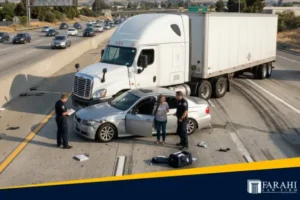
Summary
After a crash, uncertainty about fault can affect medical bills, income, and insurance claims. This guide explains car accident liability under California law, who may be responsible, required insurance coverage, and how to prove fault using evidence. It also outlines deadlines and steps to protect your rights after an accident.
Table of Contents
After a car accident, confusion over what happened and who is responsible can quickly turn into a financial risk, especially when medical bills, vehicle repairs, and lost income begin to add up.
Determining car accident liability is critical because fault directly affects whether—and how much—compensation may be available under California laws. This guide explains how car accident liability is determined in California, the factors used to establish fault, and the steps involved in proving another party’s responsibility after a crash.
Understanding Car Accident Liability
Car accident liability is a critical issue that arises when unfortunate incidents occur on the road. It refers to the legal responsibility assigned to an individual or entity for the injuries and property damages resulting from a car accident. Determining liability is essential not only for accident claims but also for legal proceedings.
In California car accident claims, liability is established by proving negligence, which is assessed using four specific legal elements:
- Duty of Care: Drivers must operate their vehicles safely and follow traffic laws to prevent harm to others.
- Breach of Duty: This occurs when a driver violates that duty, such as by speeding, driving distracted, or ignoring traffic signals.
- Causation: The breach must be directly linked to the car accident and the resulting injuries or property damage.
- Damages: The injured person must have measurable losses, including medical bills, lost income, or vehicle repair costs.
When all four elements are supported by evidence, a car accident victim may establish liability under California law and pursue compensation.
Who Can Be At Fault?
Besides the driver involved in a car accident, various individuals might be liable for injuries and losses. These can include:
- Negligent Driver: Driver negligence is the most common cause of a car accident. This may include impaired driving or failing to follow traffic laws. When a driver’s actions cause harm, they may be held financially liable for injuries and property damage.
- Vehicle Owner (Permissive Use Liability): Under California Vehicle Code §17150, the car’s owner may be liable for a car accident if they recklessly entrust their vehicle to a driver who then causes the accident.
- Driver’s Employer: The business owner or manager may be held responsible for a car accident caused by an employee while performing their duties.
- Vehicle Manufacturer or Third-Party Part Manufacturers: Manufacturers may be held accountable for a car accident in California if it is determined that the vehicle or its parts were defective.
- Government Agencies: Federal, state, or local government agencies in California may be liable for a car accident involving a government employee driving on official duty or a government-owned vehicle.
California Laws on Car Accident Liability
In California, several laws govern car accident liability, including two essential doctrines that help determine fault and explain how to prove liability in a car accident under state law.
- Comparative Negligence: California follows the pure comparative negligence rule, meaning that even if a person is partially at fault for an accident, they can still recover damages. However, the amount of accident compensation is reduced by the percentage of fault.
- Statute of Limitations: Victims of car accidents in California must file a personal injury lawsuit within two years of the date of the accident.
Auto Insurance Requirements According to California Law
California law requires all vehicle owners to carry minimum liability insurance. These updated coverage limits provide basic financial protection for car accidents that cause injuries or property damage.
|
Coverage Type |
Minimum Required Coverage |
What It Covers |
|
Bodily Injury (Per Person) |
$30,000 |
Medical expenses and related losses for one person injured in a car accident |
|
Bodily Injury (Per Accident) |
$60,000 |
Total coverage is available when two or more people are injured in the same accident |
|
Property Damage Liability |
$15,000 |
Repairs or replacement for damage to another person’s vehicle or property |
Bodily injury liability coverage helps compensate people who suffer serious injuries in a car accident. Property damage liability coverage pays for repairs or replacement when a vehicle or other property is damaged.
Car accident victims can seek compensation from their own insurance provider through uninsured/underinsured motorist coverage when the at-fault driver lacks sufficient liability insurance. This coverage also provides compensation to victims of hit-and-run accidents.
These are the minimum required limits under California law. In serious car accidents, medical costs and property damage often exceed these amounts, complicating insurance claims and increasing financial risk for injured parties.
Car owners also have the option to purchase additional insurance coverages, such as:
- Personal Injury Protection (PIP) coverage: Also known as medical payments coverage, PIP compensates for various expenses resulting from car accident injuries and provides benefits regardless of fault. It can include reimbursement for funeral/burial expenses in the event of a fatality.
- Comprehensive/collision coverage: Collision coverage covers the cost of repairs for car accident damage or reimburses the vehicle owner for the total value of a totaled vehicle. Comprehensive coverage can cover repairs for non-collision-related damage, such as weather-related damage or theft.
Proving Another Party’s Fault
If you believe another party is at fault for a car accident, consider the following steps to prove their liability.
Gather Evidence
When pursuing a car accident claim, the strength of your case relies heavily on the evidence you can present. The types of evidence you should gather to establish another party’s liability include:
- Medical Documentation: Gather all medical bills and records related to your injuries, including hospital care, medications, and rehabilitation. These documents help show the connection between the car accident and your injuries.
- Photographs of the Accident Scene: Capture detailed photographs of the damage to all vehicles involved. Include wide shots and close-ups to showcase the severity of the impact. Document any skid marks on the road and the overall condition of the road surface.
- Police Report: A police report is an official document that includes the officer’s observations, statements from involved parties, and the officer’s opinion on fault. Ensure you obtain a copy of the police report promptly, as it serves as a critical piece of evidence.
- Traffic Camera Footage: Investigate whether there are any traffic or surveillance cameras in the vicinity of the crash. Footage from these cameras can provide an unbiased visual of the events leading to the collision. It can reveal traffic law violations.
- Accident Reconstruction Experts: Consider consulting with accident reconstruction experts in complex cases. These professionals can scientifically analyze the gathered evidence to reconstruct the accident and provide expert opinions on fault.
- Vehicle Data Recorder (Black Box): If available, the black box in your vehicle can contain data such as speed, braking, and steering input just before the collision. This information can be instrumental in reconstructing the sequence of events
Obtain Witness Statements
Obtain statements from individuals who witnessed the accident. Their unbiased observations can serve as powerful corroborating evidence. Remember to collect the contact information of witnesses, including the possible at-fault driver.
File a Police Report
Ensure law enforcement is called to the scene and that a police report is filed. The report can serve as an official document detailing the circumstances of the accident.
Seek Medical Attention
Visit a healthcare professional, even if your injuries seem minor. Medical records can be crucial in establishing the link between the car crash and your injuries.
Consult with an Accident Lawyer
An experienced personal injury attorney can guide you through the legal process, help gather evidence, negotiate with auto insurance companies, and represent your interests in negotiations or court.
Consult with an Award-Winning Accident Attorney
Car accident liability can be difficult to determine, especially when multiple parties or disputed facts are involved. After a car crash, understanding how fault is assessed under California law can help protect your ability to pursue compensation.
An experienced personal injury lawyer can assist by reviewing evidence, explaining your legal options, and handling communication with claims adjusters. This support can be especially helpful when insurers question fault or attempt to limit an auto insurance claim.
Farahi Law Firm works with individuals affected by car accidents to help them understand car accident liability and the steps involved in pursuing a claim. Contact us today for a free consultation at (844) 296 5267.
FAQs
Car accident liability refers to who is legally responsible for injuries or property damage after a crash. In California, liability is usually based on whether a driver or another party acted negligently.
Insurance companies review evidence such as police reports, photos, witness statements, and medical records. Claims adjusters use this information to assess fault and determine how an auto insurance claim is handled.
Medical records, accident scene photos, traffic camera footage, and witness statements are often key. These materials help clarify incidents and are vital for proving liability in accidents.