Summary
Determining fault after a California truck accident is complex and often disputed. This guide explains how liability is established, which parties may be responsible, and why trucking cases require deeper investigation than standard car accidents. Understanding fault is critical to protecting your right to compensation.
Table of Contents
Large trucks, as defined by the National Highway Traffic Safety Administration (NHTSA), are any medium or heavy truck, excluding buses and motorhomes, with a gross vehicle weight rating greater than 10,000 pounds.
If you stroll anywhere in California, chances are you’ve already seen different trucks that are used to transporting products or materials, towing or moving houses, and delivering and recovering stranded vehicles.
According to a 2024 NHTSA report, 5,472 people were killed in crashes involving large trucks in 2023 — an 8% decrease from 5,936 in 2022. Approximately 82% of people killed in large-truck crashes in 2023 were occupants of other vehicles or non-occupants (pedestrians and cyclists), while only 18% were occupants of the large truck. In addition, 78% of fatal crashes involving large trucks occurred on weekdays, or from 6 am on Monday to 5:59 pm on Friday.
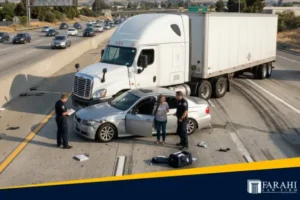
In general, all drivers must adhere to the highway protocols to ensure their safety and that of the public. During truck crashes in California, truck drivers are oftentimes blamed for the incident. However, it should be remembered that the fault should be attributed to the negligent driver. To learn about everything regarding filing a personal injury lawsuit for truck accidents, you should seek the assistance of a California truck accident attorney.
Why Determining Fault in Truck Accidents Is More Complex
Truck accident claims involve more than just two drivers. Commercial trucking cases often include multiple layers of responsibility, federal safety regulations, and corporate insurance policies. Unlike passenger vehicle crashes, determining fault may require analyzing driver logs, maintenance records, cargo loading procedures, and employer compliance with trucking laws.
Because trucking companies and insurers act quickly to limit liability, early investigation is critical to preserving evidence and protecting the injured party’s claim.
Is It Always The Truck Driver’s Fault?
No. Truck drivers are not always solely responsible for truck accidents in California. While driver error can play a role, fault often involves multiple contributing factors and parties.
Large trucks are involved in thousands of fatal and serious-injury crashes each year nationwide. Due to the size and weight of commercial vehicles, these collisions often result in severe or catastrophic harm. However, investigations frequently reveal that accidents occur because of broader safety failures, including:
- Driver fatigue or violations of hours-of-service rules
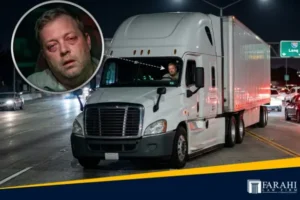
- Drunk or impaired driving
- Distracted or reckless driving
- Improper lane changes or unsafe speeds
- Mechanical failures caused by poor maintenance
- Improper cargo loading or securement
- Dangerous road conditions or weather-related hazards
Because commercial trucks require significantly longer stopping distances than passenger vehicles, even small safety violations can lead to serious rear-end or multi-vehicle crashes. These factors demonstrate why liability cannot automatically be placed on the truck driver and why determining fault often requires expert analysis rather than assumptions based solely on vehicle damage or crash location.
Categories of Truck Drivers
Depending on how a truck crash in California occurs, the responsibility for it may lie with the:
1. Owner-operator
Owner-operators are the owners and the drivers of the truck. There are two types of owner-operators: the power-only operator and the owner who owns both the tractor and the trailer.
The first operator is only the owner of the tractor, but not the trailer. On the other hand, the second operator owns both the tractor and the trailer. Unlike other drivers, owner-operators cover their miscellaneous expenses, such as occupational accident insurance, bobtail insurance, physical damage insurance, escrow accounts for maintenance of the vehicle, permits, and others.
2. Company
Company drivers are employed within the transportation industry, such as commercial trucking companies, shipping companies, and similar businesses. They get a consistent salary, access to employer-sponsored benefits, and steady home time. In addition, they do not have to pay for the fuel, scales, tolls, lumpers, or maintenance.
3. Lease Purchase
The lease purchase driving job is designed for truck drivers who want to be owner-operators but have no financial capacity to purchase a tractor. The goal of a lease program is to let the truck driver pay the tractor off through a time investment of working for the trucking company, while having the driver continue making payments until the truck gets paid off.
How To Identify Liability In a Trucking Accident
Identifying liability in commercial truck accidents is essential to filing your insurance claim and getting compensation for medical expenses and property damage. Check the following records to determine the cause of the incident and identify liability in a truck accident injury case:
1. Police report
During vehicular accidents, the persons involved in the crash usually call the police and file a police report. The police officer collects witness statements, investigates the accident scene, and issues a report. The police report helps determine the liability of the driver as stated in the rules that the latter violated, including speeding, tailgating, ignoring the protocols, and more.
2. Truck driver’s driving record
You can never be sure that a driver has been a careful driver in their entire driving career. It is necessary to take a look at the truck driver’s driving record history. Regardless of the minor collisions, these can still be pieces of evidence that could add up to the liability. The trucking company that employs a negligent driver will be aware of the risk of accidents and may share the liability of the accident perpetrated by the driver.
3. Policy of a trucking company and maintenance records
Truck companies may share liability with the truck driver in a collision caused by the latter. The companies must exercise the duty of care by strictly implementing their policies, checking their driver’s histories, and having regular maintenance, check-ups, and repairs to their company-owned vehicles. Safety issues can be prevented if companies comply with federal safety regulations and conduct due diligence.
4. Trucker’s records and black box
The trucker’s records will show what happened in the vehicle within the day, such as the type of cargo and who loaded it, which may prove if it was attributed to the accident. In addition, it will show the distance that the truck driver has driven and whether he was speeding or not. These will help establish who the negligent parties are and the types of damages to file claims for.
Similar to the airplane’s black box, a truck’s black box also records the information leading up to the crash, including the speed of the truck while traveling, GPS coordinates, dash cam recordings, and even whether the driver stepped on the brake or not.
5. Witness and expert reports
Apart from the police reports, there might be first-hand witnesses who saw the accident happen. In this case, lawyers and insurance companies may communicate with the witnesses to determine the cause of the incident and identify the responsible party. On the other hand, an expert witness may inspect the vehicle involved in a crash to determine the cause.
Federal and California Trucking Regulations That Impact Liability
Truck drivers and trucking companies must comply with strict safety regulations enforced by the Federal Motor Carrier Safety Administration (FMCSA) and California authorities. Violations of these rules can directly affect fault determinations.
Key regulations that may establish liability include:
- Hours-of-service limits to prevent driver fatigue
- Vehicle inspection and maintenance requirements
- Cargo securement standards
- Driver qualification and training rules
When these regulations are violated, they can serve as powerful evidence of negligence in a truck accident claim.
Dealing With Insurance Adjusters After a Truck Crash
Do not forget that insurance adjusters are well-trained to persuade you into accepting lowball offers in truck accident claims. Most of them may appear that they are concerned about you when they ask you questions about how you are doing after the incident, especially when you’ve experienced catastrophic injuries.
But, beware — it may result in leading questions that can lower the value of your claims, thus losing your chances to increase your insurance compensation. Insurance agents are not your friends, and having a seasoned trucking accident lawyer on your side will protect you from jeopardizing your claim.
Adjusters during the first encounter may seem friendly. However, their goal is to pay truck accident victims less than the minimum amount they deserve after the injuries they sustained. As you talk, adjusters may convince you that negotiating with them without a California truck accident attorney is easier and cheaper.
If an insurance adjuster asks for your recorded statement, do not provide one as it may be used against you in your truck accident lawsuit. Recorded statements are not mandatory nor required to be provided. Hence, you should speak to a California truck accident attorney first to know your rights when you’re involved in motor vehicle accidents.
California Laws On Truck Accidents
After being involved in accidents with commercial vehicles, you must be equipped with knowledge of California Laws on Trucks to know your rights and the compensation that you are entitled to receive. You need the help of an experienced California truck accident lawyer to obtain maximum compensation from the at-fault party.
1. Special Licenses for Trucks
The special license for trucks is called a Commercial Driver’s License (CDL). The CDL is defined as the following:
- Have a gross vehicle weight rating (commonly known as GVWR) of 26,001 pounds or more;
- Combination of vehicles with a GVWR of 26,001 lbs. or more;
- Tows another motor vehicle with a GVWR of 10,001 lbs. or more;
- Tow more than one vehicle or a trailer bus;
- Has three or more axles (excludes three-axle vehicles weighing 6,000 pounds or less gross);
- Is intended, used, or sustained to hold more than 10 passengers, counting the driver (hire or profit), or is used by any nonprofit organization or assembly.
- Necessitates hazardous material placards or is carrying material listed as a select agent or toxin in 42 CFR part 73;
- Transports hazardous wastes (Health and Safety Code §§25115 and 25117).
2. Statutes of Limitations
In California, the Statute of Limitations is two years for an individual to file a lawsuit for the damages resulting from a truck accident. Filing the claim two years thereafter will bar your capacity to sue, subject to exceptions. Remember that the exception to the rule only applies to the following:
- The injured party is proven to be mentally incompetent or incapable of filing a claim
- The party is a minor or under the age of 18. If so, the minor has until the age of 18 to file the claim, in addition to the statutory period of 2 years
- The statutory period may be extended where an injury is unknown and later discovered
Why You Need a California Truck Accident Attorney
Insurance companies are supposed to cover incidents caused by their insured. However, they have tactics to convince you to agree to lowball offers or to even avoid making fair compensation. Unfortunately, most claimants are not aware that they can sue insurance providers for bad faith.
Therefore, do not hesitate to call Farahi Law Firm‘s California truck accident attorneys! Our lawyers handle different types of accidents and will guide you on what to do during a truck crash. Our expert legal team will help you get the medical care you need and the money you deserve.
Our personal injury law firm has a proven track record of success, recovering hundreds of millions of dollars for our clients. Our team of skilled attorneys wants to do the same for you.
The legal process can be long, winding, and tricky. You need a truck accident law firm in your alley. Contact our personal injury attorneys now or call (844) 824-2955 for a free consultation.
We work on a contingency basis — no fees unless we win. Our personal injury lawyers speak English, Spanish, and Filipino.
Frequently Asked Questions About Truck Accident Fault in California
Liable parties may include the truck driver, trucking company, vehicle owner, cargo loader, maintenance provider, or manufacturers, depending on how the crash occurred and who acted negligently.
Fault is determined by reviewing evidence such as police reports, driver logs, black box data, witness statements, and whether federal or California trucking regulations were violated.
Yes. California follows a comparative fault system, meaning compensation may be reduced if multiple parties share responsibility for the accident.
Truck accident claims often involve substantial damages. Insurance companies frequently challenge fault to reduce financial exposure and settlement amounts.
An attorney coordinates accident reconstruction, secures critical records, consults qualified experts, and counters insurer tactics designed to shift or deny liability.